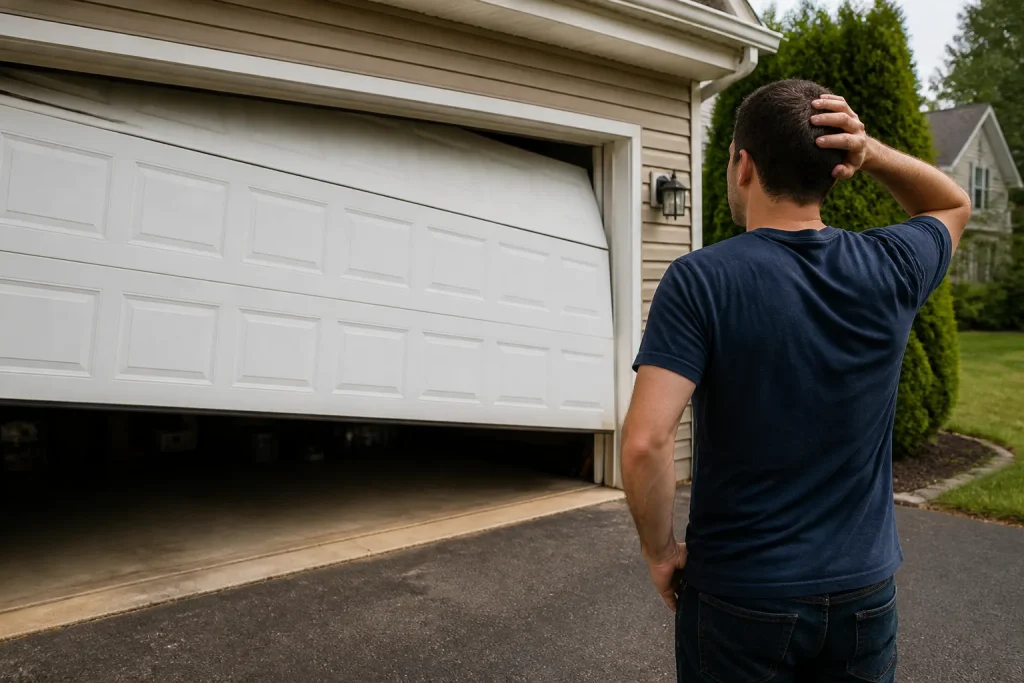
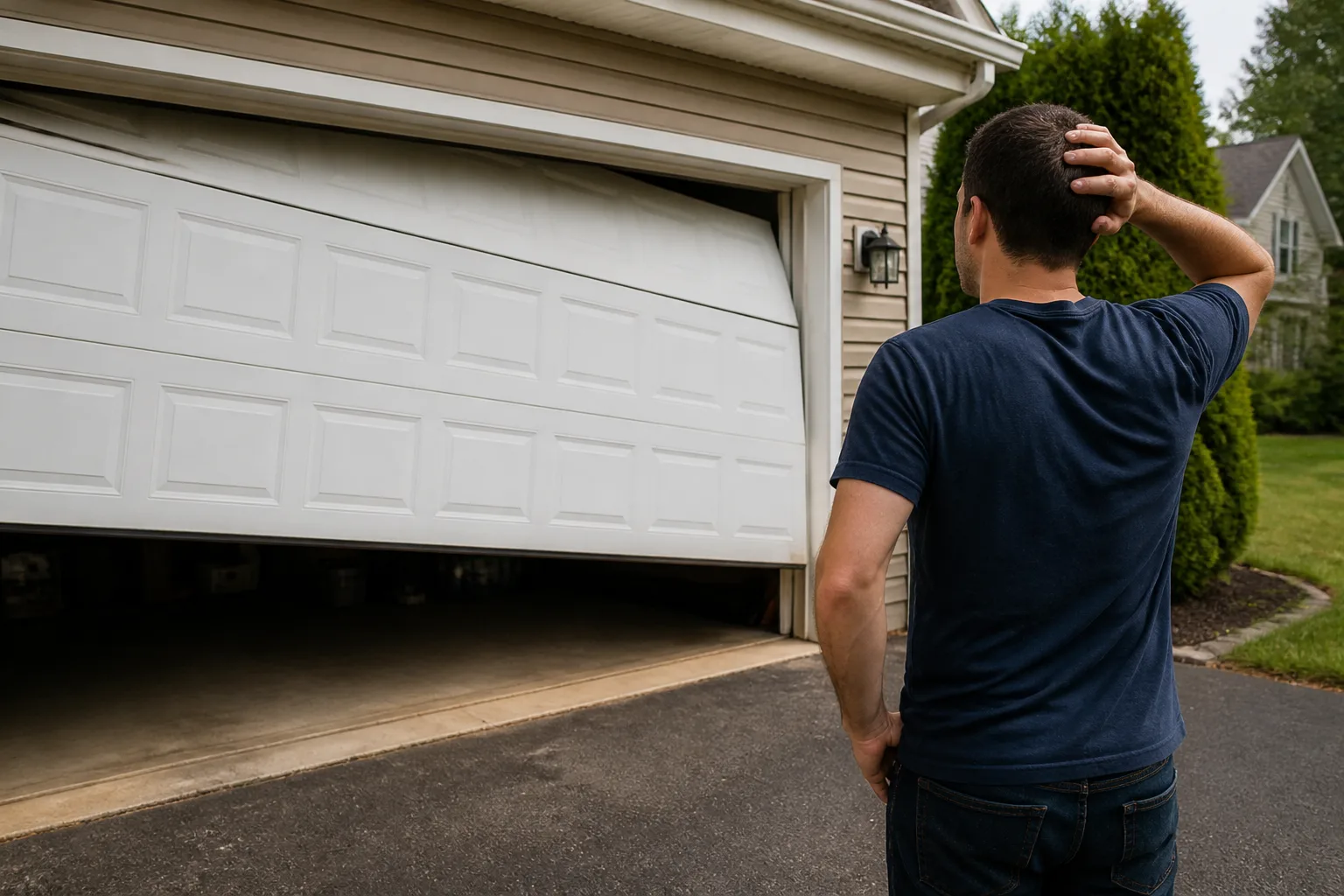
Emergency Garage Door Repair Near Me: What Toms River Homeowners Should Do First
The most common thing a homeowner does during a garage door emergency is also the thing most likely to turn a small repair into an expensive one: hitting the wall button again and again to see if it will “catch.” Each press sends power to a system that has already failed somewhere, and a straining opener can snap a cable or strip a gear that was fine ten minutes ago. Stop pressing. What you do in the next 20 minutes matters more than anything else. If you’d rather skip the guesswork, call (855) 726-7559.
What’s the first thing to do when a garage door won’t open?
Stop pressing the button and step back. Then figure out which failure you actually have before you touch anything. In Toms River, most of the emergencies we get called for fall into three buckets: the opener runs but the door doesn’t move, the door is stuck halfway and won’t budge either way, or the door came off its track entirely. Each one calls for a different first move, and getting the diagnosis right keeps you from making the repair harder.
Run through this quick sequence:
- Check the obvious stuff first. Is the opener plugged in? Has a breaker tripped? Is the wall switch working? Is the photo-eye beam blocked by something as simple as a shovel leaning against the wall or a recycling bin pushed into the path? A blocked safety sensor is one of the most common reasons a door reverses or refuses to close.
- Listen to the opener. A hum with no movement points to a stripped gear or a dead capacitor. A click and nothing else often means a logic board issue. Silence usually means power. Note what you hear, because it tells us where to start.
- Look at the door itself. Are the panels straight? Is a roller out of the track? Is a cable hanging loose? If you see a curled, slack, or snapped cable, stop here. That’s a sign the spring system has failed, and the door is now holding dangerous stored tension.
- Don’t force it. Pulling or prying a door that’s under spring tension can drop it or send a cable whipping. Leave it alone and make the call.
Our technicians have up to 14 years of experience, and the pattern is almost always the same: the door was already compromised before anyone touched it, and the button-pressing made it worse. One bit of good news – a garage door that fails is rarely subtle about it, so whatever noise or symptom you’re hearing right now is probably telling you exactly what’s wrong.
How do I safely disconnect a stuck door from the opener?
Every opener has a red emergency release cord, usually hanging from the trolley that runs along the rail. Pulling it disconnects the door from the opener so you can move the door by hand. That’s the theory. In practice, the way most people pull it is exactly how people get hurt, because they pull before they’ve checked whether the door will stay up on its own.
Here’s the order that matters:
- Close the door first if you can. If the door is fully closed, the risk of it dropping is much lower. Pull the release cord and the door should stay put.
- If the door is open or stuck partway, have someone hold it or brace it before you pull. A door with a broken spring has nothing holding it up once it’s disconnected from the opener. It will come down, and it’s heavy.
- Pull straight down, firmly and once. Don’t yank or wiggle it. If the trolley won’t release, stop and call – a jammed trolley on a LiftMaster or Chamberlain rail is a job for someone who knows the assembly.
- Never stand under the door when you pull. Step to the side.
After release, the door runs on the springs alone. On a healthy door you can lift it with one hand. If it feels impossibly heavy or won’t stay open at the halfway point, the springs are the problem, and that’s the point where you stop and call for garage door spring repair. Springs, cables, and the brackets that hold them are the most dangerous parts of the whole system, which is why our technicians handle them with proper winding bars and wound-tension tools rather than anything from a home toolbox.
How can I tell if a door is safe to move by hand?
You can judge this in about 30 seconds without touching the springs. A door that’s safe to move by hand will lift smoothly, feel balanced, and hold its position about halfway up. A door that’s unsafe will feel heavy, drop on its own, or make a sharp snap or pop when you try. If any of those things happen, leave the door where it is.
What to look at, not touch:
- The springs. A torsion spring sits on a bar above the door. An extension spring runs along the horizontal tracks. A visible gap in the coil, or a spring that looks stretched out and separated, means it has broken. Don’t touch it – the system is still under load.
- The cables. Look for a cable that’s come off its drum, is slack, or is frayed. A snapped cable means the door can drop without warning.
- The tracks. A bent track or a roller popped out of the channel can make the door bind. Move it by hand and it can jump the track completely.
- The door’s balance. Lift it a foot and let go gently. If it falls instead of holding, the counterbalance has failed.
In Toms River, we see more spring failures in the colder months when the metal contracts and becomes brittle, but springs break in July too. There’s no good season for it. What matters is that a door with a broken spring or cable should not be opened by hand and should not be left in the open position where it can come down on someone. This is the one part of a garage door job we tell every homeowner to leave alone. Call a trained technician and let the door sit until they arrive. It’s the fastest way to protect both the door and the people under it.
What should I have ready when I call for emergency repair?
Have four things ready before you dial: your door width, whether it’s a single or double door, the opener brand, and what the door is currently doing. Those details let dispatch send the right parts on the first visit instead of making a second trip, and in an emergency the second trip is the difference between back up and running the same day and waiting another day with a door hanging open.
The specifics we need:
- Door width. A single-car door is usually around 8 to 9 feet wide; a double is around 16 feet. Measure across the opening if you’re not sure.
- Door style. Sectional roll-up, one-piece tilt-up, or something else. A quick photo of the inside of the door helps more than a description.
- Opener brand and model. Check the back or side of the motor unit. If it’s a LiftMaster, Chamberlain, Genie, or a Raynor door paired with one of those openers, say so – our technicians are certified to service all of them and already know their quirks. “Your garage door opener repair is our bread and butter” isn’t just a line; the brand tells us whether it’s a logic board, a gear, or a travel-limit problem before we open the housing.
- The symptom, in plain terms. “It hums but won’t lift.” “It goes up about halfway and reverses.” “There’s a bang and now it’s stuck.” A ramp in Toms River that cleared the track, a car that bumped the bottom panel, a spring that let go during a cold snap – the symptom points to the cause.
One of the reasons we only do garage doors is that this information actually changes how we prepare. A general handyman has to figure out your Genie or Raynor on the spot. Our technicians have seen the same assemblies across the eight brands we service, so the call itself is most of the diagnosis.
What can I do if the door won’t close and I need security tonight?
A door that won’t close leaves the house open, and that’s the part that can’t wait. The temporary fixes that actually work are the ones that physically block the opening. The ones that give false confidence are the ones that just make the door look closed.
What works:
- A manual slide bolt or a C-clamp on the track. If the door is down but the opener won’t run it, lock the door in place at the track or through the latch so it can’t be lifted from outside. Clamp pliers or a C-clamp on the vertical track just above a roller does the job for the night.
- A brace across the opening. A 2×4 wedged against the door from the inside, feet braced, keeps a down door from being pushed in.
- Move valuables out of the garage. If the door is stuck open and can’t be closed, clear the tools, bikes, and anything of value into the house and shut the door between the garage and the house. That interior door is your real security line.
- Ask a neighbor to keep an eye out. Sounds low-tech, and it is, but on a Toms River street it works.
What gives false confidence: a prop rod or a chair against a door that isn’t fully seated, a piece of tape across the photo-eye, or a padlock on a track that’s already bent. None of those stop the door from being forced. They just make you feel better about it. The only real fix is a door that closes and latches properly, and that’s a repair. Call it in and let a technician get it done.
Red flags in “emergency garage door repair near me” ads
The most common red flag is an ad or listing that says “local” but routes to an out-of-state call center. The Jersey Shore market has plenty of these, and they’re easy to spot once you know what to look for. The number answers with a generic greeting and no idea what town you’re in. The “technician” who shows up is a subcontractor with a truck that isn’t marked with the company name. The quote given on the phone is not the price on the invoice.
How to check a company before you commit:
- Ask where the call is being answered. A specialist can tell you their service area and their hours without a script.
- Ask if the price is quoted before work starts. Any honest company will say yes and will hold to it. If the answer is “we’ll see when we get there,” that’s your answer.
- Look for garage-door-only focus. A company that also does plumbing and roofing is spreading its tools and its attention. A specialist has the parts for your door and opener on the call.
- Check that the phone number and address match what the ad says. A phone number that doesn’t appear anywhere else on the site is a warning.
- Ask about licensing and insurance. The local pro should be licensed and insured as the state requires. Get it confirmed before anyone touches the door.
For a full list of what we handle, see Toms River Garage Door Repair Pros. For a bent panel, a door off its track, or an opener that’s dead, our garage door repair service covers the whole job, and if you need a new door instead of a repair, that’s a scheduled measure-and-install visit with a written price, not a rushed emergency call.
When to call a pro (and when to just watch)
Call a pro for anything involving springs, cables, tracks, and openers. Watch and wait on nothing that involves a door under tension. Back up and running the same day is the goal, and getting a technician out is faster than a DIY attempt that goes wrong. If the door is stuck open, the spring has visibly broken, the door is off its track, or the opener is dead and the door won’t latch, those are all calls. If you’ve checked the breaker, the photo-eye, and the wall switch and the door still won’t move, that’s a call too. Estimates are free, and the price is quoted and agreed before any work starts, so there’s no invoice surprise waiting at the end.
Related services in Toms River: garage door opener repair, garage door spring repair, and full new door installation are all handled in-house. From a bent panel to a full new installation, one call covers it.
The Bottom Line
The 20 minutes after a garage door fails are the risky window. Stop pressing the button. Check the breaker, the photo-eye, and the wall switch first, then look at the door without touching the springs or cables. If you see a broken spring, a slack cable, or a door that won’t hold itself up, leave it alone and call. Have your door width, door style, opener brand, and symptom ready when you do. If you’re in Toms River and need help, Toms River Garage Door Repair Pros offers free estimates – call (855) 726-7559.
Frequently Asked Questions
It depends on what failed. A typical spring repair is a one-spring job priced on its own, and a matched pair usually replaced together runs about twice a single spring because both springs get replaced at the same time. Opener repairs and panel or track work are priced per job. We give a written estimate before any work starts, and that written price is what you pay. Call (855) 726-7559 for an exact quote – estimates are free.
Yes. Emergency garage door service is a standing capability, not an add-on, and we do same-day repair calls for urgent failures like a door stuck open, a snapped spring, or an opener that’s dead. Call (855) 726-7559 and tell us what the door is doing. New door installation and replacement are scheduled, so those aren’t same-day jobs – we measure first and quote in writing.
No. The price is quoted and agreed before any work starts. If we find something else once we’re on site, we tell you and quote that separately before touching it. You’re never billed for a repair you didn’t approve. Call (855) 726-7559 for a free estimate.
The local pro is licensed and insured as the state requires, and we only connect you with vetted independent local professionals. Our technicians have up to 14 years of experience and are certified to service eight major garage door and opener brands, including LiftMaster, Chamberlain, Genie, Clopay, Amarr, Wayne Dalton, Craftsman, and Raynor. Call (855) 726-7559 with your opener brand and we’ll book the right job.
Written by the team at Toms River Garage Door Repair Pros.
Need Garage Door Help?
Call Toms River Garage Door Repair Pros - the local pro we connect you with is licensed and insured, here with fast after-hours help in Toms River.
(855) 726-7559